

Summary
This article reviews hormone replacement therapy (HRT) delivery methods, including testosterone and estradiol pellets, testosterone injections, and compounded hormone creams, to help clinicians individualize treatment based on pharmacokinetics, lab monitoring, and patient-specific factors.
Introduction
Hormone Replacement Therapy, or HRT, is used to address menopausal symptoms, sexual dysfunction, fatigue, mood, cognitive changes, and to support bone density and heart health in appropriately selected men and women. When clinically indicated, HRT can reduce symptom burden, improve quality of life, and favorably influence health outcomes [1-9].
Hormones may be delivered through several dosage forms, including subcutaneous pellets, intramuscular or subcutaneous injections, topical creams, and other delivery methods. The method of delivery affects pharmacokinetics, tolerability, convenience, and ultimately adherence and satisfaction.
Before initiating therapy, clinicians should complete a structured evaluation that includes baseline laboratory assessment, symptom review, risk assessment, and discussion of therapeutic goals. Follow-up laboratory monitoring and symptom reassessment guide dose adjustments over time. HRT must be individualized. Delivery route should align with patient physiology, symptom pattern, treatment tolerance, and lifestyle.
Subcutaneous Hormone Pellets: Testosterone and Estradiol
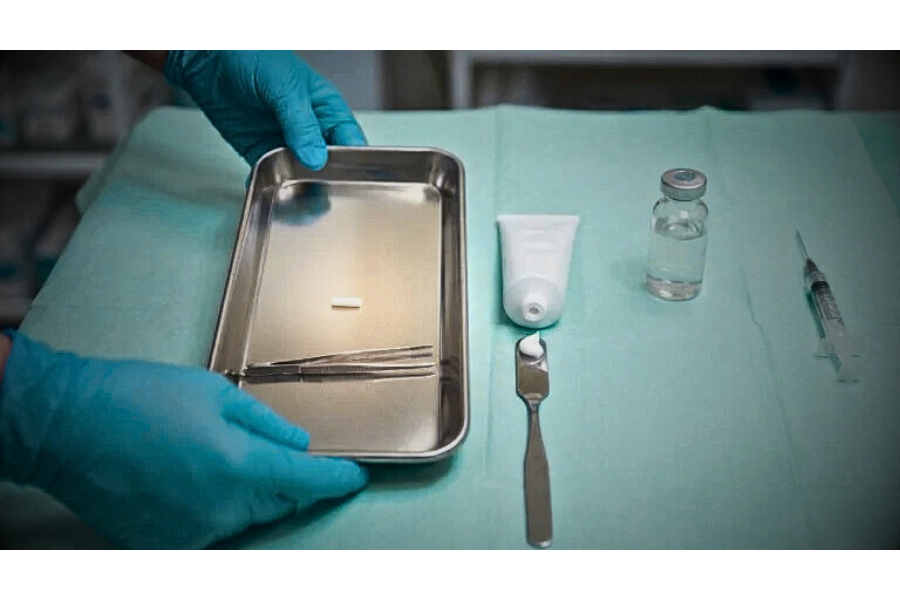
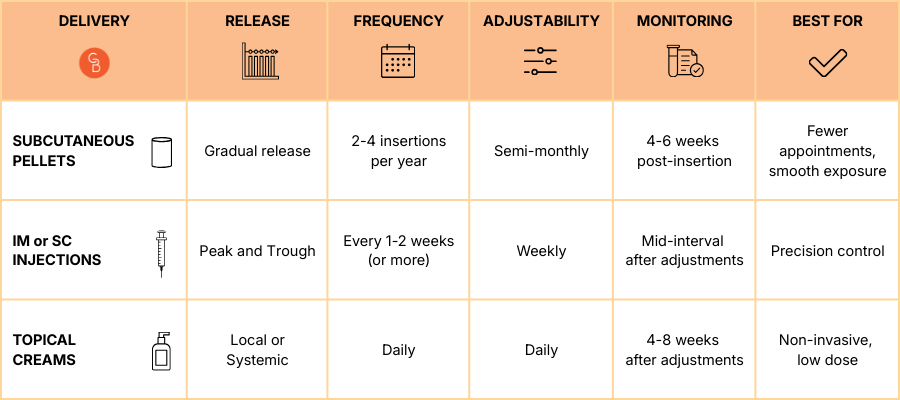
Testosterone and estradiol pellets are bioidentical hormone formulations implanted subcutaneously during a minimally invasive in-office procedure, typically in the upper gluteal or lateral hip region under local anesthesia. After insertion, pellets dissolve gradually and release hormones over several months [10]. This sustained release produces relatively stable serum concentration compared with shorter-acting formulations (i.e. injections, creams, patches) and typically requires only two to four insertions per year.
Follow-up laboratory assessment is commonly obtained four to six weeks after insertion to assess hormone levels and clinical response. Because the pellet is not intended to be removed once implanted, dosage adjustment occurs at subsequent insertion visits based on laboratory findings and symptom review.
Pellet therapy may be appropriate for patients who prefer infrequent dosing, struggle with adherence, or desire steadier hormone exposure.
Testosterone Injections: Testosterone Cypionate and Testosterone Cypionate/Testosterone Propionate
Testosterone cypionate is a long-acting ester administered via intramuscular injection into the gluteal or vastus lateralis muscles [11]. The deltoid may be used with smaller injection volumes. Subcutaneous administration into abdominal or thigh adipose tissue is supported by evidence demonstrating comparable serum testosterone concentrations and tolerability [12] and may allow self-administration. Compounded formulations that combine testosterone cypionate with testosterone propionate are used in some practices. Testosterone propionate has a shorter half-life and may provide a more rapid initial rise in serum testosterone [13], followed by the longer-acting cypionate component.
Dosing intervals often range from every one to two weeks, although more frequent administration may reduce hormonal fluctuations. After injection, serum testosterone levels rise to a peak and then decline gradually until the next dose [14]. Initial follow-up laboratory evaluation is often performed midway between the dosing interval [15], meaning dose adjustments can be implemented quickly, allowing flexible titration in response to laboratory findings or symptom changes.
Injectable therapy offers precision, adjustability, and potential for home administration. It may be appropriate for patients whose symptoms fluctuate or prefer to avoid daily application.
Compounded Hormone Creams: Estradiol, Estriol, and Testosterone
Hormone creams containing estradiol, estriol, testosterone, or combination therapy are applied topically. They may produce local effects within superficial skin layers or be absorbed across the dermis into systemic circulation, bypassing first-pass hepatic metabolism seen in oral administration [16, 17]. The degree of absorption is influenced by hormone concentration, compounding base, particle characteristics, skin integrity, regional blood flow, and application site [18, 19]. These preparations are typically dosed once daily.
Follow-up laboratory assessment is commonly performed four to eight weeks after therapy initiation or dosage change when systemic effects are intended. Dose modifications are guided by laboratory findings, symptom trajectory, and tolerability.
Topical therapy may be appropriate for patients who prefer non-invasive administration, require lower doses or localized treatment, or desire flexibility of daily titration. Clear counseling on consistent application technique and precautions to minimize unintended transfer remains essential.
Summary Table
Conclusion
Hormone Replacement Therapy can be delivered through bioidentical hormone pellets, injectable testosterone, and compounded topical creams, among other options. Each delivery system carries distinct pharmacokinetic properties, advantages, and limitations.
Successful hormone therapy begins with comprehensive baseline evaluation and clear therapeutic goals. It requires structured follow-up and evolves through individualized dose refinement. No single delivery system is inherently superior. The appropriate choice depends on patient physiology, symptom pattern, risk profile, and preference.
Carie Boyd Pharmaceuticals compounds testosterone and estradiol pellets, testosterone cypionate and combination injectable formulations, estradiol, estriol, testosterone, and combination creams, and additional hormone options. A range of delivery systems allows providers to tailor therapy while maintaining careful monitoring and evidence-informed decision-making.
- S. Food and Drug Administration. (2025, November 10). HHS advances women’s health, removes misleading FDA warnings on hormone replacement therapy [Press release]. https://www.fda.gov/news-events/press-announcements/hhs-advances-womens-health-removes-misleading-fda-warnings-hormone-replacement-therapy
- The North American Menopause Society. The 2022 hormone therapy position statement. Menopause. 2022;29(7):767–794.
- Yang, H. J., Kim, K. H., Kim, D. S., Lee, C. H., Jeon, Y. S., Shim, S. R., & Kim, J. H. (2023). The Effect of Testosterone Replacement on Sexual Function in the Elderly: A Systematic Review and Meta-Analysis. The world journal of men’s health, 41(4), 861–873. https://doi.org/10.5534/wjmh.220171
- Rojas-Zambrano, J. G., & Rojas-Zambrano, A. R. (2024). Effects of Testosterone Hormone on the Sexual Aspect of Postmenopausal Women: A Systematic Review. Cureus, 16(8), e68046. https://doi.org/10.7759/cureus.68046
- Glynne, S., Kamal, A., Kamel, A. M., Reisel, D., & Newson, L. (2025). Effect of transdermal testosterone therapy on mood and cognitive symptoms in peri- and postmenopausal women: a pilot study. Archives of women’s mental health, 28(3), 541–550. https://doi.org/10.1007/s00737-024-01513-6
- Indirli, R., Lanzi, V., Arosio, M., Mantovani, G., & Ferrante, E. (2023). The association of hypogonadism with depression and its treatments. Frontiers in endocrinology, 14, 1198437. https://doi.org/10.3389/fendo.2023.1198437
- Harper-Harrison, G., Carlson, K., & Shanahan, M. M. (2024). Hormone Replacement Therapy. In StatPearls. StatPearls Publishing.
- Bhasin S, et al. Testosterone therapy in men with hypogonadism: An Endocrine Society Clinical Practice Guideline. J Clin Endocrinol Metab. 2018;103(5):1715–1744.
- Zitzmann, M., Rastrelli, G., Murray, R. D., Edwards, D., Reisman, Y., Rao, P. M., Sahi, A., Jones, T. H., Ferlin, A., Armeni, E., Corpas, E., Cremers, J. F., David, J., Arver, S., Antonio, L., & Corona, G. (2026). Cardiovascular safety of testosterone therapy-Insights from the TRAVERSE trial and beyond: A position statement of the European Expert Panel for Testosterone Research. Andrology, 14(1), 294–302. https://doi.org/10.1111/andr.70062
- Handelsman DJ. Pharmacokinetics of testosterone pellet implants. Clin Endocrinol (Oxf). 1990;33(4):455–465.
- Nankin H. R. (1987). Hormone kinetics after intramuscular testosterone cypionate. Fertility and sterility, 47(6), 1004–1009.
- Figueiredo, M. G., Gagliano-Jucá, T., & Basaria, S. (2022). Testosterone Therapy With Subcutaneous Injections: A Safe, Practical, and Reasonable Option. The Journal of clinical endocrinology and metabolism, 107(3), 614–626. https://doi.org/10.1210/clinem/dgab772
- Fujioka, M., Shinohara, Y., Baba, S., Irie, M., & Inoue, K. (1986). Pharmacokinetic properties of testosterone propionate in normal men. The Journal of clinical endocrinology and metabolism, 63(6), 1361–1364. https://doi.org/10.1210/jcem-63-6-1361
- Snyder PJ et al. Effects of testosterone treatment in older men. N Engl J Med. 2016;374:611–624.
- Mulhall JP, Trost LW, Brannigan RE et al: Evaluation and management of testosterone deficiency: AUA guideline. J Urol 2018; 200: 423.
- Stumpf P. G. (1990). Pharmacokinetics of estrogen. Obstetrics and gynecology, 75(4 Suppl), 9S–17S. https://pubmed.ncbi.nlm.nih.gov/2179793/
- Baker V. L. (1994). Alternatives to oral estrogen replacement. Transdermal patches, percutaneous gels, vaginal creams and rings, implants, other methods of delivery. Obstetrics and gynecology clinics of North America, 21(2), 271–297.
- Farjami, A., Salatin, S., Jafari, S., Mahmoudian, M., & Jelvehgari, M. (2021). The Factors Determining the Skin Penetration and Cellular Uptake of Nanocarriers: New Hope for Clinical Development. Current pharmaceutical design, 27(42), 4315–4329. https://doi.org/10.2174/1381612827666210810091745
- Law, R. M., Ngo, M. A., & Maibach, H. I. (2020). Twenty Clinically Pertinent Factors/Observations for Percutaneous Absorption in Humans. American journal of clinical dermatology, 21(1), 85–95. https://doi.org/10.1007/s40257-019-00480-4