

Introduction
For decades, declining testosterone levels in men have been attributed to the natural process of aging. It is well-established that serum testosterone (T) concentrations tend to decrease as men grow older, contributing to a range of health issues from reduced libido to increased body fat, fatigue, depression, and diminished muscle and bone mass. However, emerging research indicates that this age-related decline may be only part of a larger, more complex picture. Evidence now points to a broader, population-wide decline in testosterone that transcends age and appears to disproportionately affect younger generations of men [1].
This article highlights the major findings of the Massachusetts Male Aging Study (MMAS), a long-term, population-based study, which reveals a generational decline in testosterone levels in United States men over time. These findings may have significant implications for clinical practice and public health.
Generational Testosterone Decline: Insights from the Massachusetts Male Aging Study
The MMAS followed the health and hormone levels of randomly selected men aged 45–79 living in the greater Boston area, with data collected in three waves over nearly two decades: 1987–1989 (T1), 1995–1997 (T2), and 2002–2004 (T3). This longitudinal design enabled researchers to distinguish between age-related declines and generational shifts in testosterone levels.
Researchers discovered that testosterone levels declined not just with age, but also across successive generations. For example, a 60-year-old man measured in 1989 had a higher average serum testosterone level than a 60-year-old man measured in 1995, an observation consistent across multiple age cohorts. The average serum testosterone dropped from 501 ng/dL at baseline to 391 ng/dL at the final follow-up.
Importantly, the study found that the average decline in testosterone over time was approximately 1.2% per year, even when comparing age-matched men. The decline remained statistically significant even after adjusting for common contributing factors such as smoking, obesity, and medication use [1].
Causes of Low Testosterone: Beyond Aging
The proportion of men taking multiple medications increased over the course of the study. However, this trend did not explain the testosterone drop when statistically controlled. Smoking is associated with higher testosterone levels and cessation can slightly reduce testosterone. Yet, the significant reduction in smoking prevalence across cohorts still failed to explain the magnitude of the testosterone decline [1, 2].
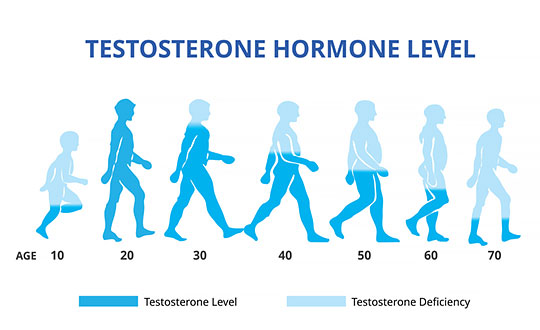
In summary, although health behaviors and chronic disease prevalence changed over time, they did not fully explain the generational shift in testosterone concentrations. This has prompted increased interest in environmental and societal influences.
Environmental and Lifestyle Factors That Lower Testosterone
Emerging data suggests that environmental exposures might play a role in this hormonal shift. Chemicals such as phthalates, parabens, and bisphenol A (BPA), commonly found in plastics, packaging, cosmetics, and industrial products, have been shown to interfere with the body’s endocrine system. These endocrine-disrupting chemicals (EDCs) can mimic or block the action of natural hormones, including testosterone. Long-term exposure, even at low levels, may have subtle yet cumulative effects on male reproductive health [3]. It has also been speculated that increasing ambient temperatures in homes and workplaces over the last several decades, due to central heating, may negatively affect scrotal thermoregulation, subtly impairing both testosterone production and spermatogenesis [4]. Additionally, modern humans are spending more time seated and indoors, with reduced exposure to sunlight and physical activity. Sedentary behavior and lack of exercise are independently associated with lower testosterone levels, while resistance training and regular activity are known to increase T concentrations [5, 6]. Finally, highly processed, nutrient-poor diets, increasing work-related stress, and poor sleep hygiene have all been linked to disruptions in the hypothalamic-pituitary-gonadal (HPG) axis [7, 8].
Over time, the cumulative effect of these lifestyle factors may contribute to widespread hormonal disruption. Although not quantified precisely, these environmental influences offer credible explanations for the persistent decline in testosterone that cannot be explained by age alone.
Limitations of Current Testosterone Research
Despite the robustness of the MMAS, several limitations warrant consideration. The study population was limited to the greater Boston area. While demographically representative, the findings may not fully generalize to all U.S. populations or men in different climates, socioeconomic divisions, or ethnic groups. Although statistically significant, the 1.2% annual decline in age-adjusted testosterone levels may appear modest at first glance. The clinical impact of this trend depends on individual baseline levels and symptom presentation. Because the study did not gather data on specific environmental exposures, such as endocrine-disrupting chemicals or occupational stress, it limits the ability to draw conclusions about causality. Nevertheless, the consistency of the findings over nearly 20 years and across multiple waves strengthens the concern that this is a real, ongoing public health issue.
How Providers Can Address Low Testosterone in Men
For providers, this study offers several key takeaways:
- Consider testosterone screening even in younger men who present with symptoms such as fatigue, low libido, depression, or increased body fat. Reference ranges may need adjustment over time as generational baselines shift downward.
- Weight management, regular exercise, improved sleep, and stress reduction are crucial lifestyle modifications that can meaningfully support testosterone levels.
- Patients should be informed of avoidable exposures to EDCs, particularly through dietary plastics, household products, and cosmetics.
- Providers should evaluate candidates holistically, considering comorbidities, fertility goals, and individual preferences.
When appropriately selected and closely monitored, testosterone therapy can improve mood, energy, libido, body composition, and quality of life. Visit our hormone product pages or request a product catalog to see how Carie Boyd Pharmaceuticals can help.
Final Thoughts on Declining Testosterone in Men
The age-independent decline in testosterone documented by the MMAS reveals a concerning public health trend. As newer generations of men exhibit lower baseline testosterone levels, the implications for physical, sexual, and emotional health may become more pronounced over time.
While the cause is likely multifactorial, encompassing health status, environment, and modern lifestyle, providers must recognize these patterns early. A proactive, holistic approach can mitigate the impact of this decline, help identify contributing factors, and offer support.
References:
- Travison, T. G., Araujo, A. B., O’Donnell, A. B., Kupelian, V., & McKinlay, J. B. (2007a). A Population-Level Decline in Serum Testosterone Levels in American Men. J Clin Endocrinol Metab, 92(1), 196–202
- Field, A. E., Colditz, G. A., Willett, W. C., Longcope, C., & McKinlay, J. B. (1994). The relation of smoking, age, relative weight, and dietary intake to serum adrenal steroids, sex hormones, and sex hormone-binding globulin in middle-aged men. J Clin Endocrinol Metab, 79(5), 1310–1316.
- Skakkebæk, N. E., Rajpert-De Meyts, E., & Main, K. M. (2006). Testicular dysgenesis syndrome: An increasingly common developmental disorder with environmental aspects. Human Reproduction, 16(5), 972–978.
- Healio. (2007, February 1). Testosterone levels declined in men over time, study finds. Retrieved from https://www.healio.com/news/endocrinology/20070201/testosterone-levels-declined-in-men-over-time-study-finds
- Vingren JL, Kraemer WJ, Ratamess NA, Anderson JM, Volek JS, Maresh CM. Testosterone physiology in resistance exercise and training: the up-stream regulatory elements. Sports Med. 2010 Dec 1;40(12):1037-53.
- Travison, T. G., Araujo, A. B., Kupelian, V., O’Donnell, A. B., & McKinlay, J. B. (2006). The relative contributions of aging, health, and lifestyle factors to serum testosterone decline in men. J Clin Endocrinol Metab, 91(2), 444–449.
- Wrzosek M, Woźniak J, Włodarek D. The causes of adverse changes of testosterone levels in men. Expert Rev Endocrinol Metab. 2020 Sep;15(5):355-362. doi: 10.1080/17446651.2020.1813020. Epub 2020 Oct 20. PMID: 33076711.
- Patel P, Shiff B, Kohn TP, Ramasamy R. Impaired sleep is associated with low testosterone in US adult males: results from the National Health and Nutrition Examination Survey. World J Urol. 2019 Jul;37(7):1449-1453. doi: 10.1007/s00345-018-2485-2. Epub 2018 Sep 17. PMID: 30225799.