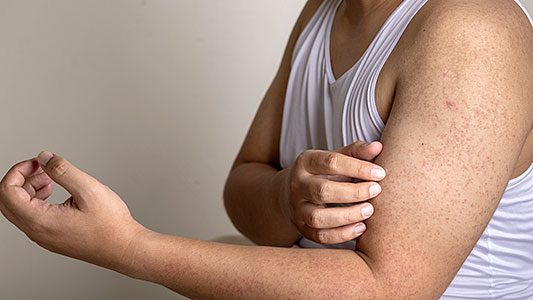
Rx Only
Silicone Gel
- For new or old scars
- Skin-friendly fatty acids and lipids
- Lightweight option
- 30 g pump
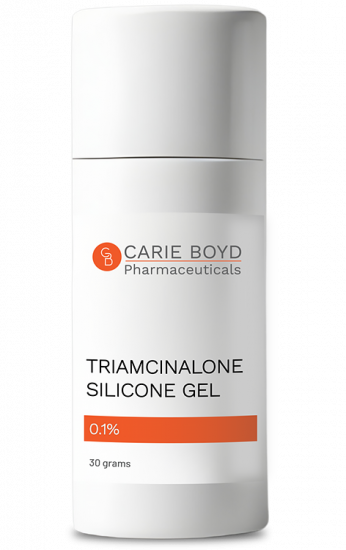
This silicone gel contains triamcinolone acetonide 0.1%. It is available by prescription in a 30 g pump.
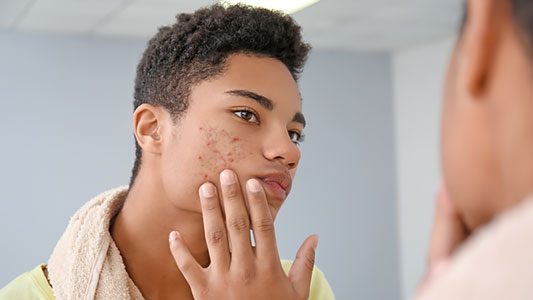
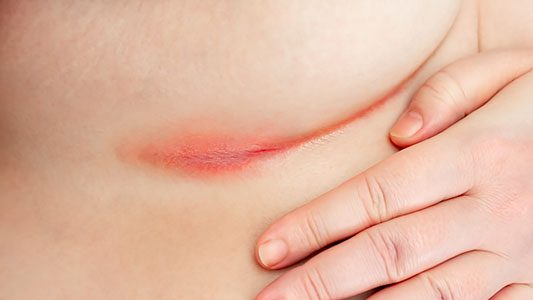
This combination is formulated in a silicone gel, and is formulated to support the care of both new and old scars. It contains a blend of silicones in a semipermeable polymer network and pracaxi oil, which is rich in skin-friendly fatty acids and lipids. The formula promotes a soothing and nurturing environment while providing long-lasting moisturization that protects the skin barrier and helps reduce water loss. Patients have used this silicone gel to help improve the appearance of scars, including keloid and acne scars.
Triamcinolone is a corticosteroid that acts through anti-inflammatory, antipruritic, and vasoconstrictive actions [1], suppresses inflammatory mediators, inhibits fibroblast proliferation, reduces collagen production, and decreases expression of scar biomarkers [2].
Silicone gel creates a semi-occlusive barrier, increases stratum corneum hydration, and alters cytokine-mediated signaling from keratinocytes to fibroblasts [3].
This silicone gel may be considered by providers treating patients who are concerned with scar appearance.
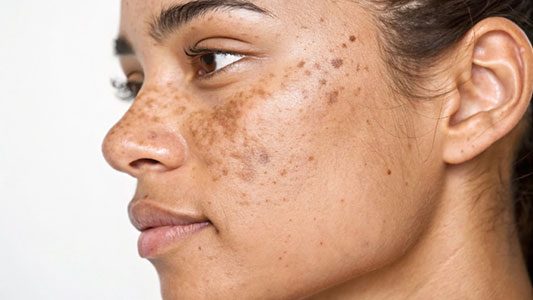
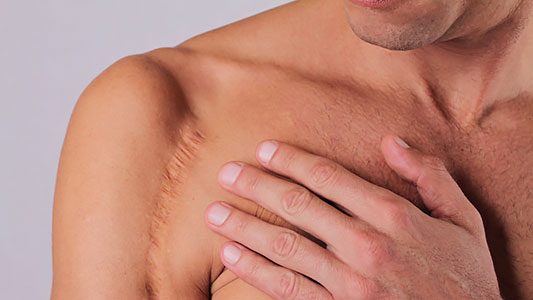
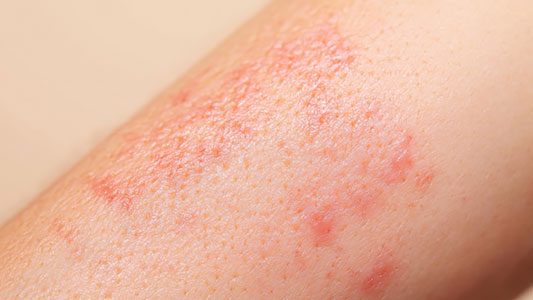
Scars develop as part of the wound healing process and vary by how the skin repairs itself. Hypertrophic scars are raised but remain within the wound boundaries and are linked to excessive extracellular matrix (ECM) deposition [4, 5]. Keloid scars extend beyond the original wound and can continue to grow, often recurring despite treatment. Atrophic scars appear sunken or depressed, commonly after acne or infections [6, 7]. Contracture scars tighten the skin and may restrict movement, especially after burns, while stretch marks (striae) occur when skin stretches rapidly, such as during pregnancy or weight gain. These scar types reflect disruptions in collagen synthesis, degradation, and remodeling, which shape their final appearance [4, 6, 8].
Topical triamcinolone acetonide in silicone gel improves scar appearance by combining triamcinolone’s anti-inflammatory effects with silicone’s hydration and fibroblast modulation [1, 2, 3]. Triamcinolone suppresses scar formation in both animal models and human hypertrophic scar fibroblasts [2], while silicone gel significantly enhances scar outcomes, including in hypertrophic scars and keloids [3]. Together, they provide complementary benefits: triamcinolone reduces inflammation and collagen production, and silicone supports occlusion, hydration, and cytokine modulation, making this combination an favorable approach to managing abnormal scarring.
1. PRESCRIBER & PATIENT INFORMATION
Prescribing clinician’s name, licensing information, address and contact information. Patients’ full name, date of birth, shipping address and contact information.
2. COMPLETE PRESCRIPTION INFORMATION
Include: drug, dosage, and dosage form, quantity, SIG, and refills if requested.
3. PRESCRIPTION TRANSMITTAL
Fax: (940) 382-2694
Phone: 940-382-6758 | Speak to a pharmacist
Escribe ID: 0903012660 or CARIE BOYD Pharmaceuticals
• Select Medication from the drop-down menu (bulk ingredient or powder is OK)
• Use the words Please Compound in the SIG or Comments section followed by the compounded medication you want to prescribe.
NOTE: If you cannot find the same strength or form, that’s OK, write exactly what you want into the SIG or Comments section. In most cases we’ll be able to custom compound the prescribed medication.
Store at controlled room temperature. Protect from light.
[1] Aidarex Pharmaceuticals LLC. (2015). Triamcinolone acetonide cream [Package insert]. Ascend Laboratories LLC. https://dailymed.nlm.nih.gov/dailymed/drugInfo.cfm?setid=
[2] Wu Z, Huang D, Xie J, Li M, Chen P, Yu Z. Triamcinolone acetonide suppressed scar formation in mice and human hypertrophic scar fibroblasts in a dose-dependent manner. Cell Mol Biol (Noisy-le-grand). 2023 Aug 31;69(8):226-231. doi: 10.14715/cmb/2023.69.8.35. PMID: 37715376.
[3] Mustoe TA. Evolution of silicone therapy and mechanism of action in scar management. Aesthetic Plast Surg. 2008 Jan;32(1):82-92. doi: 10.1007/s00266-007-9030-9. Epub 2007 Oct 30. PMID: 17968615.
[4] Kidzeru EB, Lebeko M, Sharma JR, Nkengazong L, Adeola HA, Ndlovu H, P Khumalo N, Bayat A. Immune cells and associated molecular markers in dermal fibrosis with focus on raised cutaneous scars. Exp Dermatol. 2023 May;32(5):570-587. doi: 10.1111/exd.14734. Epub 2023 Feb 20. PMID: 36562321; PMCID: PMC10947010.
[5] Pym K. Identifying and managing problem scars. Br J Nurs. 2006 Jan 26-Feb 8;15(2):78-82. doi: 10.12968/bjon.2006.15.2.20367. PMID: 16493282.
[6] Moon J, Yoon JY, Yang JH, Kwon HH, Min S, Suh DH. Atrophic acne scar: a process from altered metabolism of elastic fibers and collagen fibers based on transforming growth factor-β1 signaling. Br J Dermatol. 2019 Dec;181(6):1226-1237. doi: 10.1111/bjd.17851. Epub 2019 Jul 9. PMID: 30822364.
[7] Fabbrocini G, Annunziata MC, D’Arco V, De Vita V, Lodi G, Mauriello MC, Pastore F, Monfrecola G. Acne scars: pathogenesis, classification and treatment. Dermatol Res Pract. 2010;2010:893080. doi: 10.1155/2010/893080. Epub 2010 Oct 14. PMID: 20981308; PMCID: PMC2958495.
[8] Chawla S, Ghosh S. Regulation of fibrotic changes by the synergistic effects of cytokines, dimensionality and matrix: Towards the development of an in vitro human dermal hypertrophic scar model. Acta Biomater. 2018 Mar 15;69:131-145. doi: 10.1016/j.actbio.2018.01.002. Epub 2018 Jan 10. PMID: 29330036.
- (940) 382-6758
- Monday through Friday 9:00 am - 6:00 pm CT
- [email protected]