Rx Only
Gel
- Unique steroid-free combination
- Hydroquinone-free option
- Niacinamide for barrier, pigment, and irritation benefits
- 30 g pump
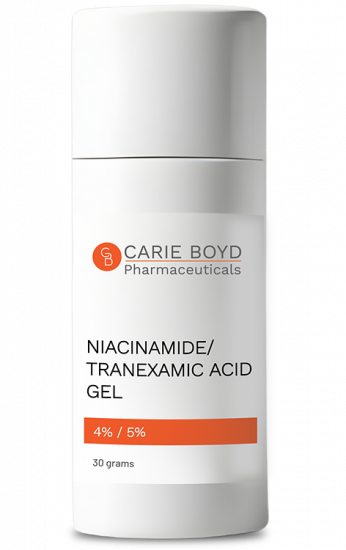
This topical gel contains niacinamide 4% and tranexamic acid 5%. It is available by prescription in a 30 g pump.
This combination is formulated in an anhydrous gel. This smooth, creamy base has a refined cosmetic feel, leaving no greasy or tacky residue. It provides emollient, moisturizing effects that soften skin while delivering active ingredients.
Niacinamide is also known as vitamin B3 and nicotinic acid. The existing clinical data and literature on niacinamide suggests that it is an inexpensive, safe drug with beneficial effects as an adjunct in many dermatological diseases because of its anti-inflammatory, anti-oxidant, barrier repair and protective effects. It can be used as a topical drug without any major adverse effects [1].
Tranexamic acid (TXA) is a synthetic lysine derivative that helps reduce hyperpigmentation by inhibiting plasmin activity and the release of inflammatory mediators involved in melanin production. It decreases both plasmin and tyrosinase activity, leading to reduced melanocyte stimulation and melanin synthesis [2]. Additionally, TXA’s anti-inflammatory effects, including the inhibition of prostaglandins like PGE2, further support its role in improving skin tone and minimizing discoloration [3].
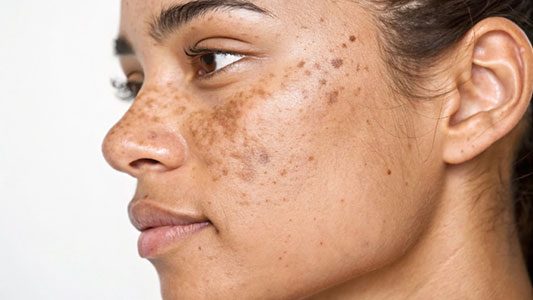
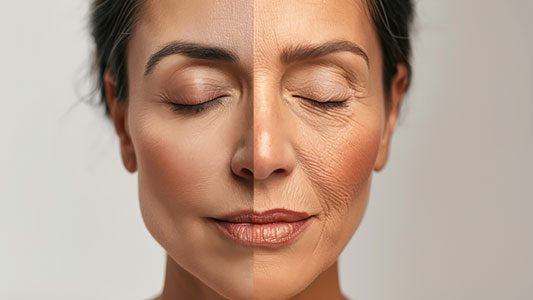
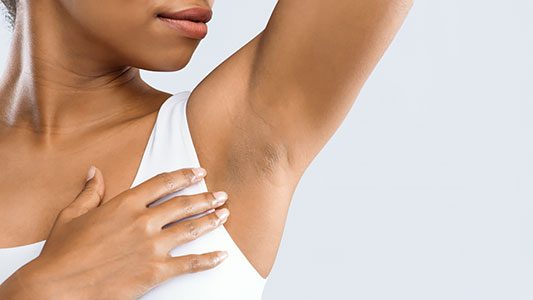
Skin color disorders can be caused by various factors, such as excessive exposure to sunlight, aging and hormonal imbalance during pregnancy, or taking some medications. This combination gel may be considered by providers treating patients with melasma, freckles, or other areas with melanin hyperpigmentation.
The skin, as the largest organ of the human body, serves as the primary barrier against environmental factors. Constantly exposed to ultraviolet (UV) radiation, pollution, and other external stressors, it relies on internal defense mechanisms to maintain its integrity and function. One such mechanism is melanogenesis—the enzymatic process by which melanin is produced to protect the skin from UV damage [4]. However, when melanin production is disturbed or unevenly distributed, it can lead to hyperpigmentation, a common cosmetic and dermatological concern. This typically presents as irregular, darker patches of skin, often occurring in areas frequently exposed to sunlight. Post-inflammatory hyperpigmentation can also develop after skin trauma or inflammation and may persist for weeks to years. Inflammation triggers the release of prostaglandins, leukotrienes, and thromboxanes, which stimulate melanocyte activity and increase melanin synthesis in the epidermis [5].
Multiple studies and reviews support the use of TXA and niacinamide for hyperpigmentation, PIH, and melasma. A 2019 study in the Journal of Drugs in Dermatology showed that a topical serum with TXA and niacinamide significantly improved PIH, hyperpigmentation, and melasma in Brazilian women with Fitzpatrick skin types I–IV [6]. Similarly, a 2014 study in Skin Research and Technology found that niacinamide combined with TXA reduced irregular facial pigmentation in Korean women [7].
1. PRESCRIBER & PATIENT INFORMATION
Prescribing clinician’s name, licensing information, address and contact information. Patients’ full name, date of birth, shipping address and contact information.
2. COMPLETE PRESCRIPTION INFORMATION
Include: drug, dosage, and dosage form, quantity, SIG, and refills if requested.
3. PRESCRIPTION TRANSMITTAL
Fax: (940) 382-2694
Phone: 940-382-6758 | Speak to a pharmacist
Escribe ID: 0903012660 or CARIE BOYD Pharmaceuticals
• Select Medication from the drop-down menu (bulk ingredient or powder is OK)
• Use the words Please Compound in the SIG or Comments section followed by the compounded medication you want to prescribe.
NOTE: If you cannot find the same strength or form, that’s OK, write exactly what you want into the SIG or Comments section. In most cases we’ll be able to custom compound the prescribed medication.
Store at controlled room temperature. Protect from light.
[1] Bains P, Kaur M, Kaur J, Sharma S. Nicotinamide: Mechanism of action and indications in dermatology. Indian J Dermatol Venereol Leprol 2018;84:234-237
[2] Gaćina K, Krstanović Ćosić A. THE USE OF TRANEXAMIC ACID IN DERMATOLOGY. Acta Clin Croat. 2023;62(2):368-372. doi:10.20471/acc.2023.62.02.16
[3] Chen T, Xue J, Wang Q. Tranexamic Acid for the Treatment of Hyperpigmentation and Telangiectatic Disorders Other Than Melasma: An Update. Clin Cosmet Investig Dermatol. 2024;17:2151-2163. Published 2024 Sep 25. doi:10.2147/CCID.S479411
[4] Brenner M, Hearing VJ. The protective role of melanin against UV damage in human skin. Photochem Photobiol. 2008;84(3):539-549. doi:10.1111/j.1751-1097.2007.00226.x
[5] Wawrzyk-Bochenek I, Rahnama M, Stachura M, Wilczyński S, Wawrzyk A. Evaluation of the Reduction of Skin Hyperpigmentation Changes under the Influence of a Preparation Containing Kojic Acid Using Hyperspectral Imaging-Preliminary Study. J Clin Med. 2023;12(7):2710. Published 2023 Apr 4. doi:10.3390/jcm12072710
[6] Desai S, Ayres E, Bak H, Manco M, Lynch S, Raab S, Du A, Green D, Skobowiat C, Wangari-Talbot J, Zheng Q. Effect of a Tranexamic Acid, Kojic Acid, and Niacinamide Containing Serum on Facial Dyschromia: A Clinical Evaluation. J Drugs Dermatol. 2019 May 1;18(5):454-459. PMID: 31141852.
[7] Lee DH, Oh IY, Koo KT, Suk JM, Jung SW, Park JO, Kim BJ, Choi YM. Reduction in facial hyperpigmentation after treatment with a combination of topical niacinamide and tranexamic acid: a randomized, double-blind, vehicle-controlled trial. Skin Res Technol. 2014 May;20(2):208-12. doi: 10.1111/srt.12107. Epub 2013 Sep 5. PMID: 24033822.
- (940) 382-6758
- Monday through Friday 9:00 am - 6:00 pm CT
- [email protected]