Rx Only
Gel
- 3-in-1 nightly regimen
- Antibiotic + anti-inflammatory + comedolytic
- Once-daily pump for simplicity
- 30 g pump
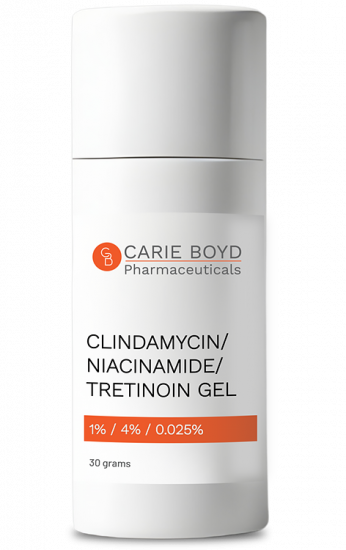
This topical gel contains clindamycin 1%, niacinamide 4%, and tretinoin 0.025%. It is available by prescription in a 30 g pump.
This combination is formulated in an anhydrous gel. This smooth, creamy base has a refined cosmetic feel, leaving no greasy or tacky residue. It provides emollient, moisturizing effects that soften skin while delivering active ingredients.
Clindamycin inhibits bacterial protein synthesis by binding to the 23S RNA of the 50S ribosomal subunit, acts as a bacteriostatic agent against Propionibacterium acnes (now known as Cutibacterium acnes) [1] and provides anti-inflammatory properties that complement tretinoin’s effects [2].
Tretinoin is a cornerstone in acne therapy, reducing microcomedo formation by decreasing cohesiveness of follicular epithelial cells, stimulating mitotic activity, normalizing desquamation, and increasing extrusion of comedones [3, 4].
Niacinamide provides complementary anti-inflammatory effects, improves barrier function, regulates sebum production, and has shown significant benefits in reducing both inflammatory and non-inflammatory lesions [5]. Combination approaches enhance treatment outcomes: tretinoin with niacinamide targets multiple pathogenic factors of acne while mitigating irritation [4, 5], and the triple combination addresses keratinization, inflammation, and barrier dysfunction [5, 6].
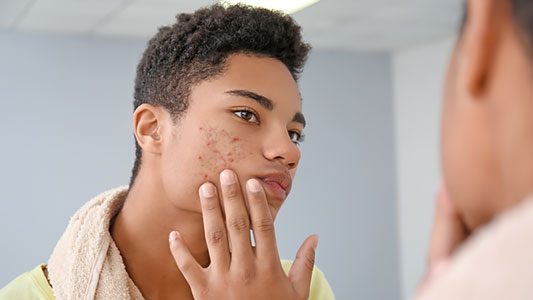
This product may be considered by providers treating patients with acne. Acne vulgaris arises from multiple interacting mechanisms, including follicular hyperkeratinization, excess sebum production, microbial colonization, and inflammatory pathways. Abnormal desquamation of the follicular epithelium causes obstruction of the pilosebaceous canal, with comedonal keratinocytes exhibiting increased desmosomes and tonofilaments that promote microcomedone formation [7, 8]. Sebaceous gland activity is strongly influenced by insulin and insulin-like growth factor-1, both of which stimulate sebum secretion [9]. Cutibacterium acnes contributes to pathogenesis through the production of proinflammatory mediators such as lipases, proteases, hyaluronidases, and chemotactic factors that recruit leukocytes [8, 10]. Inflammation is further amplified by C. acnes activation of toll-like receptors and CD14 on keratinocytes and sebocytes, inflammasome activation, neutrophil and macrophage infiltration, and shifts in proinflammatory lipid profiles [8, 9]. Additional contributors include genetic susceptibility, as well as neurogenic influences where stress-induced substance P stimulates sebaceous gland proliferation and differentiation [8].
Topical clindamycin/tretinoin combination therapy is highly effective for acne treatment through complementary mechanisms of action, with clinical trials showing 21–41% treatment success rates in patients with moderate acne vulgaris [2, 3]. The combination accelerates resolution of all types of acne lesions without compromising safety, while the addition of clindamycin to tretinoin enhances comedolytic efficacy in moderate-to-severe facial acne [2].
Tretinoin is a cornerstone topical retinoid in acne therapy, providing comedolytic and anti-inflammatory effects that resolve precursor microcomedones and help maintain long-term clearance [11].
Niacinamide has emerged as an effective complementary agent, with studies showing that combinations such as 4% niacinamide with other actives improve acne outcomes, while niacinamide-containing moisturizers used alongside anti-acne medications significantly reduce lesions and irritation [12, 5].
1. PRESCRIBER & PATIENT INFORMATION
Prescribing clinician’s name, licensing information, address and contact information. Patients’ full name, date of birth, shipping address and contact information.
2. COMPLETE PRESCRIPTION INFORMATION
Include: drug, dosage, and dosage form, quantity, SIG, and refills if requested.
3. PRESCRIPTION TRANSMITTAL
Fax: (940) 382-2694
Phone: 940-382-6758 | Speak to a pharmacist
Escribe ID: 0903012660 or CARIE BOYD Pharmaceuticals
• Select Medication from the drop-down menu (bulk ingredient or powder is OK)
• Use the words Please Compound in the SIG or Comments section followed by the compounded medication you want to NOTE: If you cannot find the same strength or form, that’s OK, write exactly what you want into the SIG or Comments section. In most cases we’ll be able to custom compound the prescribed medication.
Store at controlled room temperature. Protect from light.
[1] U.S. Food and Drug Administration. (n.d.). Clindamycin Phosphate – Clindamycin Phosphate Lotion [Package Insert]. Bryant Ranch Prepack. Retrieved from https://dailymed.nlm.nih.gov
[2] Abdel-Naser MB, Zouboulis CC. Clindamycin phosphate/tretinoin gel formulation in the treatment of acne vulgaris. Expert Opin Pharmacother. 2008 Nov;9(16):2931-7. doi: 10.1517/14656566.9.16.2931. PMID: 18937624.
[3] Bryant Ranch Prepack, Inc. (2024, February). Tretinoin cream – Tretinoin gel [package insert]. Burbank, CA. Manufactured for Mylan Pharmaceuticals Inc.
[4] Weiss JS, Shavin JS. Topical retinoid and antibiotic combination therapy for acne management. J Drugs Dermatol. 2004 Mar-Apr;3(2):146-54. PMID: 15098969.
[5] Tempark T, Shem A, Lueangarun S. Efficacy of ceramides and niacinamide-containing moisturizer versus hydrophilic cream in combination with topical anti-acne treatment in mild to moderate acne vulgaris: A split face, double-blinded, randomized controlled trial. J Cosmet Dermatol. 2024 May;23(5):1758-1765. doi: 10.1111/jocd.16212. Epub 2024 Feb 1. PMID: 38299457.
[6] Auffret N, Claudel JP, Leccia MT, Ballanger F, Dreno B. Novel and emerging treatment options for acne vulgaris. Eur J Dermatol. 2022 Jul 1;32(4):451-458. English. doi: 10.1684/ejd.2022.4306. PMID: 36301760.
[7] Russell JJ. Topical therapy for acne. Am Fam Physician. 2000 Jan 15;61(2):357-66. PMID: 10670502.
[8] Toyoda M, Morohashi M. Pathogenesis of acne. Med Electron Microsc. 2001 Mar;34(1):29-40. doi: 10.1007/s007950100002. PMID: 11479771.
[9] Tan JKL, Stein Gold LF, Alexis AF, Harper JC. Current Concepts in Acne Pathogenesis: Pathways to Inflammation. Semin Cutan Med Surg. 2018 Jun;37(3S):S60-S62. doi: 10.12788/j.sder.2018.024. PMID: 30192343.
[10] Knor T. The pathogenesis of acne. Acta Dermatovenerol Croat. 2005;13(1):44-9. PMID: 15788147.
[11] Leyden J, Stein-Gold L, Weiss J. Why Topical Retinoids Are Mainstay of Therapy for Acne. Dermatol Ther (Heidelb). 2017 Sep;7(3):293-304. doi: 10.1007/s13555-017-0185-2. Epub 2017 Jun 5. PMID: 28585191; PMCID: PMC5574737.
[12] Kozan A, Guner RY, Akyol M. A retrospective assessment and comparison of the effectiveness of benzoyl peroxide; the combination of topical niacinamide, gallic acid, and lauric acid; and the combination of benzoyl peroxide and erythromycin in acne vulgaris. Dermatol Ther. 2020 Jul;33(4):e13534. doi: 10.1111/dth.13534. Epub 2020 Jun 25. PMID: 32390309.
- (940) 382-6758
- Monday through Friday 9:00 am - 6:00 pm CT
- [email protected]