Rx Only
CREAM
- Triple-keratolytic approach
- One tube regimen
- 35-Day BUD
- 30 g pump
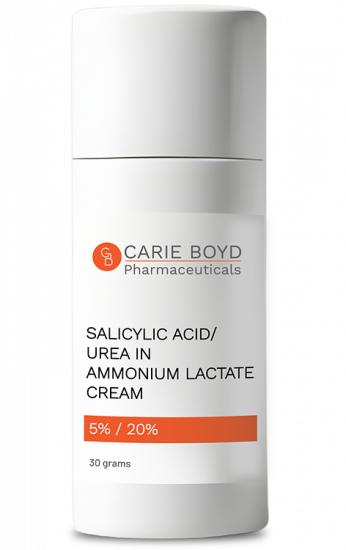
This topical cream contains salicylic acid 5% and urea 20% in an ammonium lactate cream. It is available by prescription in a 30 g pump.
This product is formulated in a highly versatile, elegant oil-in-water cream designed for compounding a wide range of formulations. It is proven through permeation studies to effectively carry both lipophilic and hydrophilic drugs across a wide pH range. Clinically tested as hypoallergenic, dermatology approved, it is enriched with Aloe Vera and Vitamin E. This base functions as an all-day moisturizer, offering a non-greasy, patient-friendly option.
Salicylic acid acts as a keratolytic by reducing keratinocyte binding and dissolving intercellular cement [1], while urea serves as a humectant and keratolytic, enhancing hydration and promoting desquamation [2]. Ammonium lactate functions as an alpha-hydroxy acid that decreases corneocyte cohesion and improves stratum corneum hydration [3, 4].
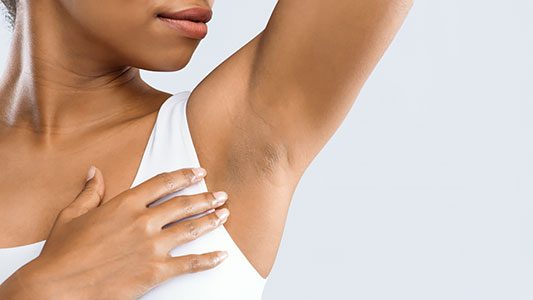
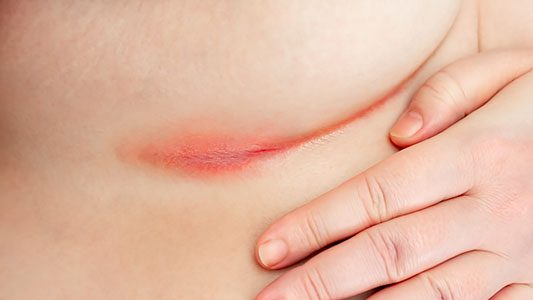
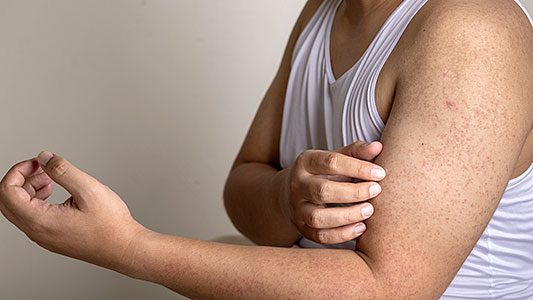
This product may be used by a provider treating patients with keratosis pilaris.
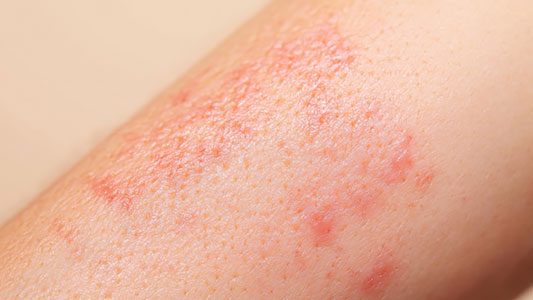
Keratosis pilaris (KP) is primarily caused by excessive keratin buildup around hair follicles due to genetic factors, with mutations in the FLG and ABCA12 genes implicated in its pathogenesis [5]. The disorder is characterized by follicular hyperkeratinization and keratin plugging, resulting in small folliculocentric keratotic papules with variable perifollicular erythema and a stippled “gooseflesh” appearance, most often affecting the extensor arms, thighs, and buttocks [5, 6]. KP is frequently associated with ichthyosis vulgaris, palmar hyperlinearity, and atopic conditions; it may also occur in individuals with hay fever, asthma, or eczema. Several variants exist, including keratosis pilaris simplex (most common), keratosis pilaris rubra (with prominent erythema), erythromelanosis follicularis faciei et colli (involving face and neck), and keratosis pilaris atrophicans (with atrophic changes) [5].
Clinical studies show that salicylic acid cream (5%) reduced keratosis pilaris (KP) lesions by 52% after 12 weeks and is the second most prescribed first-line treatment [4, 7]; urea cream (20%) significantly improved skin texture after 4 weeks with reported increases in patient confidence [2]. Treatment guidelines recommend 10% urea cream for mild KP, 10% lactic acid or 5% salicylic acid for moderate KP, and combination therapy for severe cases, with initial therapy lasting 8–12 weeks followed by maintenance, as recurrence is common within 3 months of discontinuation [7].
1. PRESCRIBER & PATIENT INFORMATION
Prescribing clinician’s name, licensing information, address and contact information. Patients’ full name, date of birth, shipping address and contact information.
2. COMPLETE PRESCRIPTION INFORMATION
Include: drug, dosage, and dosage form, quantity, SIG, and refills if requested.
3. PRESCRIPTION TRANSMITTAL
Fax: (940) 382-2694
Phone: 940-382-6758 | Speak to a pharmacist
Escribe ID: 0903012660 or CARIE BOYD Pharmaceuticals
• Select Medication from the drop-down menu (bulk ingredient or powder is OK)
• Use the words Please Compound in the SIG or Comments section followed by the compounded medication you want to prescribe.
NOTE: If you cannot find the same strength or form, that’s OK, write exactly what you want into the SIG or Comments section. In most cases we’ll be able to custom compound the prescribed medication.
Store at controlled room temperature. Protect from light.
[1] Trinity Pharmaceuticals, LLC. (n.d.). Salicylic acid—Salicylic acid lotion [Package insert]. Retrieved from https://dailymed.nlm.nih.gov
[2] McCormick E, Nussbaum D, Friedman A, Pham H, Meckfessel MH, Emesiani C. Evaluation of a Moisturizing Cream with 20% Urea for Keratosis Pilaris. J Drugs Dermatol. 2024 Jan 1;23(1):1274-1277. doi: 10.36849/JDD.7806. PMID: 38206153.
[3] A-S Medication Solutions. (n.d.). Ammonium lactate—Ammonium lactate lotion [Package insert]. Retrieved from https://dailymed.nlm.nih.gov
[4] Kootiratrakarn T, Kampirapap K, Chunhasewee C. Epidermal permeability barrier in the treatment of keratosis pilaris. Dermatol Res Pract. 2015;2015:205012. doi: 10.1155/2015/205012. Epub 2015 Feb 24. PMID: 25802513; PMCID: PMC4354723.
[5] Kodali N, Patel VM, Schwartz RA. Keratosis pilaris: an update and approach to management. Ital J Dermatol Venerol. 2023 Jun;158(3):217-223. doi: 10.23736/S2784-8671.23.07594-1. Epub 2023 May 11. PMID: 37166753.
[6] Hwang S, Schwartz RA. Keratosis pilaris: a common follicular hyperkeratosis. Cutis. 2008 Sep;82(3):177-80. PMID: 18856156.
[7] Greenzaid J, Nussbaum D, Friedman A. Keratosis Pilaris: Treatment Practices of Board-Certified Dermatologists. J Drugs Dermatol. 2023 Oct 1;22(10):985-989. doi: 10.36849/JDD.7534. PMID: 37801530.
- (940) 382-6758
- Monday through Friday 9:00 am - 6:00 pm CT
- [email protected]